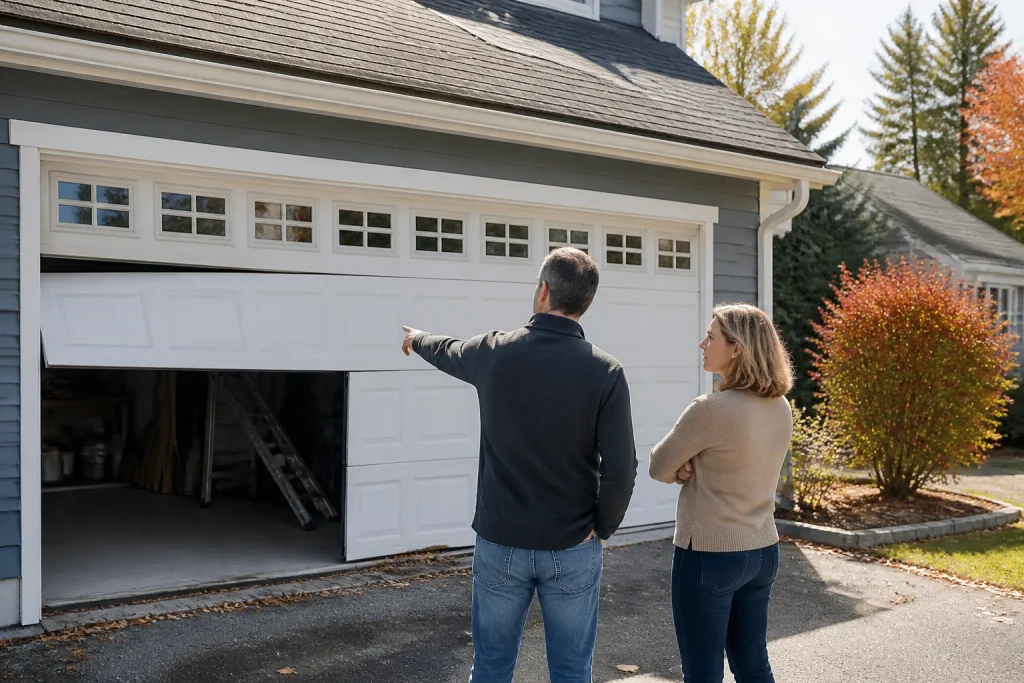
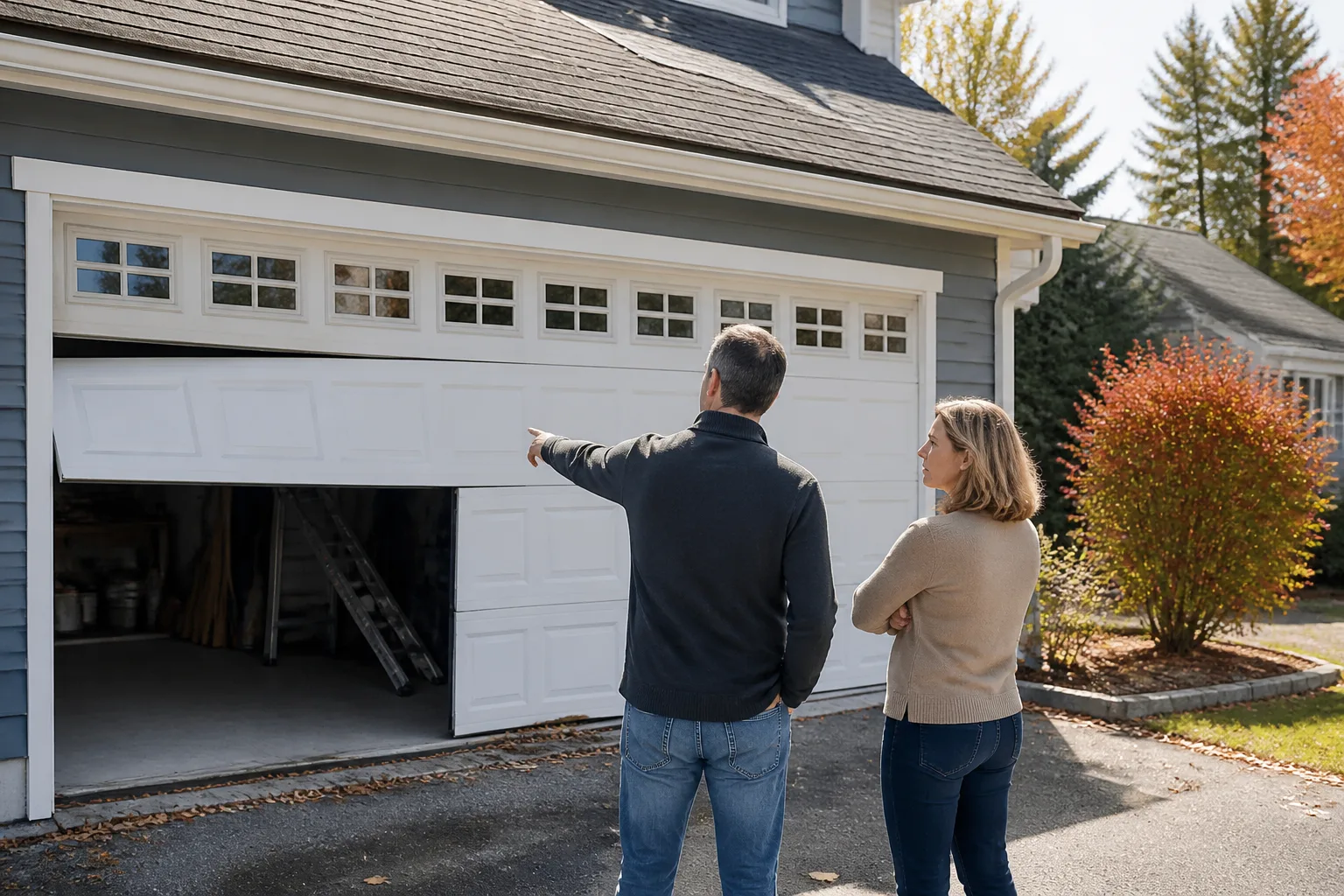
Garage Door Repair: Repair or Replace? How Norwich Homeowners Decide
Most homeowners assume the decision comes down to age: past ten years, replace it. That rule of thumb fails more often than it works. A 15-year-old door with one broken spring is almost always worth repairing. A 7-year-old door with repeated cable failures, track drift, and an opener that strains on every cycle usually isn’t. The real question isn’t how old your door is. It’s whether the failure is isolated to one part or spread across the whole system.
If you’d rather have a trained eye look at it than guess, call (877) 517-6532. Estimates are free, and we’ll tell you plainly which side of that line your door falls on.
Why the “Replace Anything Over 10 Years” Rule Fails in Norwich
A garage door isn’t a refrigerator. Appliances wear out as a unit and get swapped out as a unit. A garage door is a mechanical system with five separate subsystems that age at completely different rates. One part can fail at year fifteen while the other four are still solid, and that’s a repair. Or several can fail together at year seven, and that’s a different conversation.
In our experience across Norwich, the age rule sends people in the wrong direction in both ways. It pushes homeowners with a single worn spring into replacing a door that had years left. And it gives false comfort to someone whose door is only a few years old but has a pattern of problems building underneath.
Here’s the useful reframe: think in failure patterns, not birthdays. An isolated failure points to repair. A systemic pattern points to replacement. The next section shows you how to tell which one you’re looking at.
The Systemic vs. Isolated Failure Framework
Audit your door across its five main subsystems. You’re not diagnosing anything yourself; you’re taking inventory so you can have an informed conversation with a technician. Here’s what to look at for each one:
- Panels. One dented or cracked section is an isolated failure and can usually be replaced on its own. If several panels are warped, bowed, or showing rot along the bottom edge, the door’s structure is compromised and replacement starts to make more sense.
- Springs. A single broken spring is the classic isolated repair. Torsion or extension springs do the heavy lifting on every cycle, and when one lets go it says nothing about the rest of the door. Springs on both sides failing within a short window is a different story. Spring work is genuinely dangerous, so this is one part of the audit you should only ever observe from a distance.
- Cables. One frayed cable can be replaced. Cables that keep failing, or that have jumped the drum more than once, usually point to an alignment or tension problem underneath. That’s systemic.
- Tracks. Slight bends from a bump can be straightened. Tracks that have drifted out of plumb, or that pull away from the frame repeatedly, suggest the door has been running out of balance for a while.
- The opener. An opener that struggles, reverses randomly, or runs hot on every cycle is either worn out itself or straining against a door that’s out of balance. Which one it is matters, and it’s often the pivot point in the whole decision.
If four subsystems look healthy and one has failed, repair. If three or more are showing problems, get a replacement quote before you spend money on parts.
How Norwich’s Freeze-Thaw Cycle Changes the Math
This is a local factor that homeowners moving from warmer states consistently underestimate. Norwich gets repeated freeze-thaw cycles through the colder months. Water works into the seams and bottom edges of a garage door, freezes, expands, thaws, and repeats. Over enough seasons that cycling accelerates two things: panel warping on steel doors and rot along the bottom section of wood doors.
In a southern climate, a ten-year-old steel door often looks and behaves like new. Here, the same door can have a wavy bottom panel, a swollen wood section, and a weather seal that no longer sits flush. That matters for the repair-versus-replace call because panel and section damage from moisture isn’t a single-part failure. It tends to creep across the door.
So when you’re auditing a Norwich door, look hard at the bottom edge and the seams. If the damage is one section, replacing that section is reasonable. If the warp or rot has spread, chasing it panel by panel usually costs more over time than a new door built for the climate. That’s a genuinely different recommendation than you’d get in a milder market, and it’s why a local technician’s eye matters more than a general rule.
When an Opener Replacement Is the Pivot Point
This is where a lot of Norwich homeowners spend money in the wrong order. Two mistakes show up again and again.
Mistake one: a new opener on a failing door. If the panels are warped, the tracks are drifting, or the springs are near the end of their life, a new opener will work harder than it should from day one. You’ve paid for new electronics and handed them a door that fights them on every cycle. Fix the door first, or replace it.
Mistake two: a new door without checking opener compatibility. A heavier or differently balanced door can overwhelm an older opener that was sized for the original. Modern openers from LiftMaster, Chamberlain, Genie, and Craftsman often pair with newer safety and smart-home features that an old unit simply doesn’t have. If you’re replacing the door, the opener needs to be part of the conversation, not an afterthought.
If your opener is the only thing failing and the door itself is sound, that’s a clean repair. Our garage door opener repair work covers the major smart-compatible brands, and we diagnose by system rather than swapping parts until something works. The key question to ask any technician: is my opener failing on its own, or is it straining against a door problem?
The Real Cost Comparison for Norwich Homeowners
Most repair-versus-replace comparisons stop at parts and labor. That’s only part of the picture, and it leaves out the costs that actually move the decision for Norwich homeowners.
- Repair costs. Spring, cable, track, and opener repairs are priced per job after a technician sees the door. What you’re comparing is that number against the replacement figure, not a generic estimate.
- Energy efficiency. A newer insulated door can hold warmth in a garage that shares a wall with living space, which matters through a Norwich winter. If your current door is uninsulated and the room behind it is cold, factor that in.
- Insurance. Some homeowners find their policy terms shift after a major replacement versus a series of smaller claims. It’s worth a call to your insurer to ask how they treat it.
- Resale. In Norwich’s housing market, a garage door is one of the most visible features a buyer sees on approach. A door that’s clearly failing reads as deferred maintenance on a walkthrough. A well-functioning door from a recognized manufacturer like Clopay or Amarr helps the whole house present better.
The honest structure: total up what repairing every failing subsystem would cost. Compare that to a replacement quote that includes opener compatibility. If repairs approach half the cost of replacement on a door already showing systemic wear, replacement usually wins on value over the next several years.
How to Get a Straight Answer, Not a Sales Pitch
A technician recommending replacement isn’t automatically wrong, and a technician recommending repair isn’t automatically honest. The difference shows up in the questions they’re willing to answer. Here’s what to ask:
- “Which subsystems are actually failing?” A technician who can name them specifically, and point to what they see, is diagnosing. A vague answer about the door being “old” is a pitch.
- “If we repair this, what’s the next most likely failure, and roughly when?” An honest answer includes the risk of a second repair coming soon. That’s information you deserve before you decide.
- “Will a new opener work with my current door, and will a new door work with my current opener?” If they only answer one direction, they’re not thinking about the system.
- “Can you give me a written estimate for both paths?” Repair and replacement, priced separately, in writing. The written estimate is the price, and it’s agreed before any work starts.
When you’re comparing, remember that the price is quoted and agreed before work begins, on both paths. No surprises on the invoice. That’s the standard we hold to on every job in Norwich, whether it’s a single spring or a full new door.
When to Call a Pro
Spring work and cable work are the two parts of a garage door system you should never touch yourself. Those components hold serious tension, and a released spring or cable can cause severe injury. If you hear a loud snap and the door won’t lift, or you see a frayed cable, leave the door down and call. Our garage door spring repair technicians handle the parts most people shouldn’t go near.
Our technicians have up to 8 years of experience, and we work on equipment from Wayne Dalton, Craftsman, and Clopay among other major brands, which means we’re diagnosing by system rather than guessing. For the wider range of work we handle, see our full garage door repair service.
Related Services in Norwich
If your door is stuck or your spring has snapped and you need help now, our Garage Door Repair Norwich team is here to assess it. For a new door once you’ve decided replacement makes sense, we install full doors and handle the opener compatibility question as part of the job.
The Bottom Line
Repair versus replace isn’t about how old your door is. It’s about whether the damage is isolated to one subsystem or spread across several. Audit the panels, springs, cables, tracks, and opener. If one has failed and the rest are sound, repair. If three or more are showing problems, get a replacement quote and treat the opener as part of that decision, not a separate one. Norwich’s freeze-thaw cycle pushes bottom-section wear faster than in milder climates, so check those bottom edges carefully.
And whatever you decide, get a written estimate for both paths, with the price agreed before work starts. If you’re in Norwich and need help, Garage Door Repair Norwich offers free estimates. Call (877) 517-6532.
Frequently Asked Questions
If only one part has failed, like a single spring or a bent track, repair is almost always the better value on a 15-year-old door in Norwich. Age alone doesn’t justify replacement. Check whether the panels, cables, tracks, and opener are still sound. If four out of five subsystems are healthy, repair it.
Call (877) 517-6532 for a free estimate and an honest read on which side you’re on.
Prices in Norwich are quoted per job after a technician inspects the door, since cost depends on which subsystem failed and what parts the repair needs. A written estimate for both repair and replacement paths is the best way to compare. Estimates are free.
Call (877) 517-6532 to schedule one.
Only if the opener is the actual problem. If the door is out of balance or the springs are worn, a new opener will struggle just as much, and you’ll have paid for electronics that fight the door on every cycle. A technician should confirm which part is failing before recommending an opener replacement.
Call (877) 517-6532 and we’ll diagnose the system before you spend anything.
Often yes, if the damage is limited to one panel or one section. In Norwich, freeze-thaw wear tends to spread along the bottom edge and seams, so a repair only makes sense if the neighboring sections are sound. If the rot or warping has crept across multiple panels, replacement is usually the better investment.
Call (877) 517-6532 for a free assessment of the damage.
Written by the team at Garage Door Repair Norwich.
Need Garage Door Help?
Call Garage Door Repair Norwich - the local pro we connect you with is licensed and insured, here with fast after-hours help in Norwich.
(877) 517-6532